With the intensification of global climate change, the impact of extreme weather events such as typhoons on the marine ecological environment has garnered increasing attention. Polycyclic aromatic hydrocarbons (PAHs), a class of persistent and biotoxic organic pollutants, have environmental behaviors in the ocean that are deeply influenced by changes in dynamic conditions. Polycyclic aromatic hydrocarbons (PAHs), as a class of persistent and bio-toxic organic pollutants, exhibit environmental behaviors in the ocean that are profoundly influenced by dynamic environmental changes. However, how typhoons affect the distribution and fate of PAHs in the upper ocean at large spatial scales and high temporal resolution has remained poorly understood due to a lack of detailed observational studies.
Recently, the Frontier Research Group of Marine Carbon Cycling from the Southern Marine Science and Engineering Guangdong Laboratory (Zhuhai), in collaboration with research teams from Sun Yat-sen University and Guangdong Ocean University, utilized the unique opportunity presented by the passage of Typhoon Chaba across the South China Sea in 2022. For the first time, they have provided a detailed elucidation of the "cleaning effect" of typhoons on organic pollutants in the upper ocean and its underlying mechanisms. The research team conducted field sampling and observations one week before and one week after the typhoon's passage. The results showed that after the typhoon, the total concentration of 15 US EPA priority PAHs (TPAHs) in the surface water of the South China Sea significantly decreased from 220 ± 160 ng/L before the typhoon to 120 ± 42.5 ng/L after, representing a substantial reduction of 45%. Concurrently, the particle-water partition coefficient (Kd) increased by 73%. Analysis of a 24-hour continuous monitoring station revealed that TPAH concentrations in the surface layer of the water column were significantly higher than those at the bottom of the mixed layer, while Kd values exhibited the opposite trend.
The study further revealed the physical-environmental chemical mechanism of this "cleaning effect": the intense vertical mixing induced by the typhoon disrupted the stratified structure of the upper ocean, enhancing the partitioning and transformation of dissolved PAHs (especially 4-ring compounds) into particulate forms, which were then rapidly removed from the mixed layer through particle sinking. It is estimated that within 24 hours after the typhoon's passage, a total of approximately 703 kg of PAHs was cleared from the upper mixed layer across the study area, which spans 2.65 × 10⁴ km². This study not only enhances the understanding of the biogeochemical processes of organic pollutants influenced by typhoons, but also provides a valuable reference for assessing the contribution of extreme weather events to the fate of global marine pollutants.
The related research fingding was published online in the journal Environmental Chemistry and Ecotoxicology (Volume 8, 2026, Pages 1195-1206) in January 2026, under the tittle "Exploring the cleaning effect of a typhoon on polycyclic aromatic hydrocarbons in the upper-ocean of the Northern South China Sea." The first author of the paper is Yicheng Li, a graduate student from Sun Yat-sen University, and the corresponding author is Dr. Yali Li.
The study was jointly supported by the National Natural Science Foundation of China (NSFC, Grant No 42406165), the Southern Marine Science and Engineering Guangdong Laboratory (Zhuhai) (projects SML2024P024 and SMI2023SP206), the School of Marine Sciences, Group of Air-Sea Interaction, Sun Yat-Sen University, and the Zhuhai Basic and Applied Basic Research Foundation (Grant No 2220004002467).
The original article link: https://doi.org/10.1016/j.enceco.2026.01.027
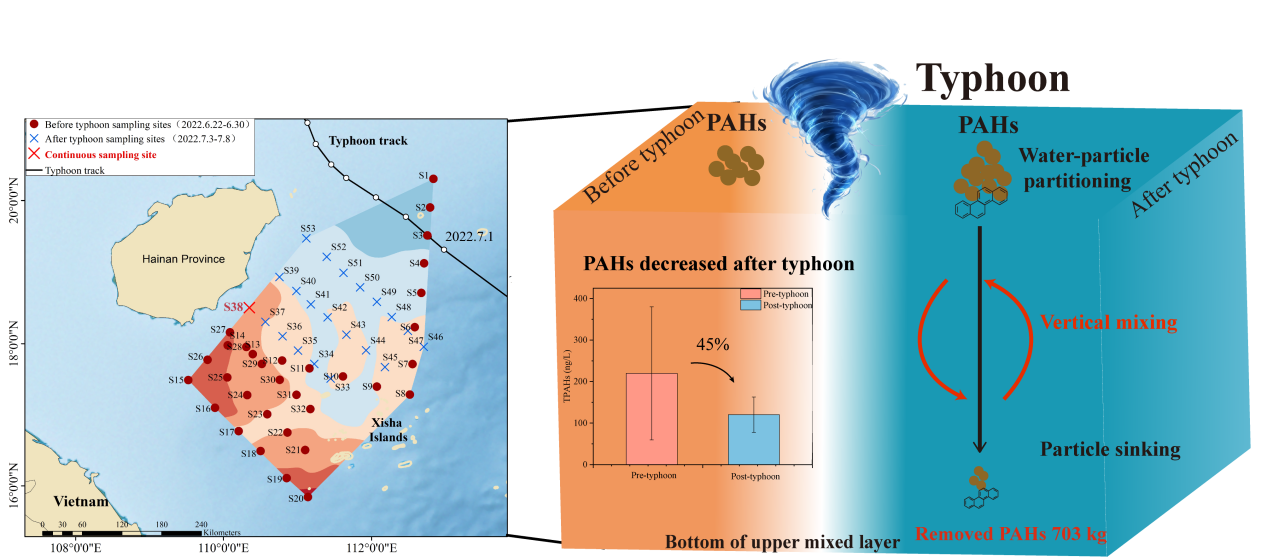
Distribution of total polycyclic aromatic hydrocarbon (TPAH) concentrations in the study area and a schematic diagram of the mechanism of the typhoon's "cleaning effect" on PAHs.
Photo from: Exploring the cleaning effect of a typhoon on polycyclic aromatic hydrocarbons in the upper-ocean of the Northern South China Sea https://doi.org/10.1016/j.enceco.2026.01.027