Keywords: Antarctic, Ross Sea, Slope Current, Heat Budget, Energy Cycle, Circulation Variability, Numerical Modeling
The Ross Sea, located in the South Pacific sector (Figure 1), is the second-largest marginal sea in Antarctica and one of the most significant source regions for Antarctic Bottom Water. As Antarctic Bottom Water acts as the "abyssal engine" of the global ocean's deep circulation, its formation rate and properties directly impact the global thermohaline circulation and climate change. Furthermore, the Ross Sea adjoins the world's largest ice shelf—the Ross Ice Shelf—to the south. The stability of this ice shelf is crucial for the fate of the vast volume of grounded ice behind it, exerting a potential "switch-like" influence on global sea-level rise. The key factor regulating basal melting of the Ross Ice Shelf is the oceanic heat delivered to its front, underscoring that the complex heat budget, energy cycle, and circulation variability within the Ross Sea—driven collectively by wind, buoyancy forcing, and tides—are the core processes involved.
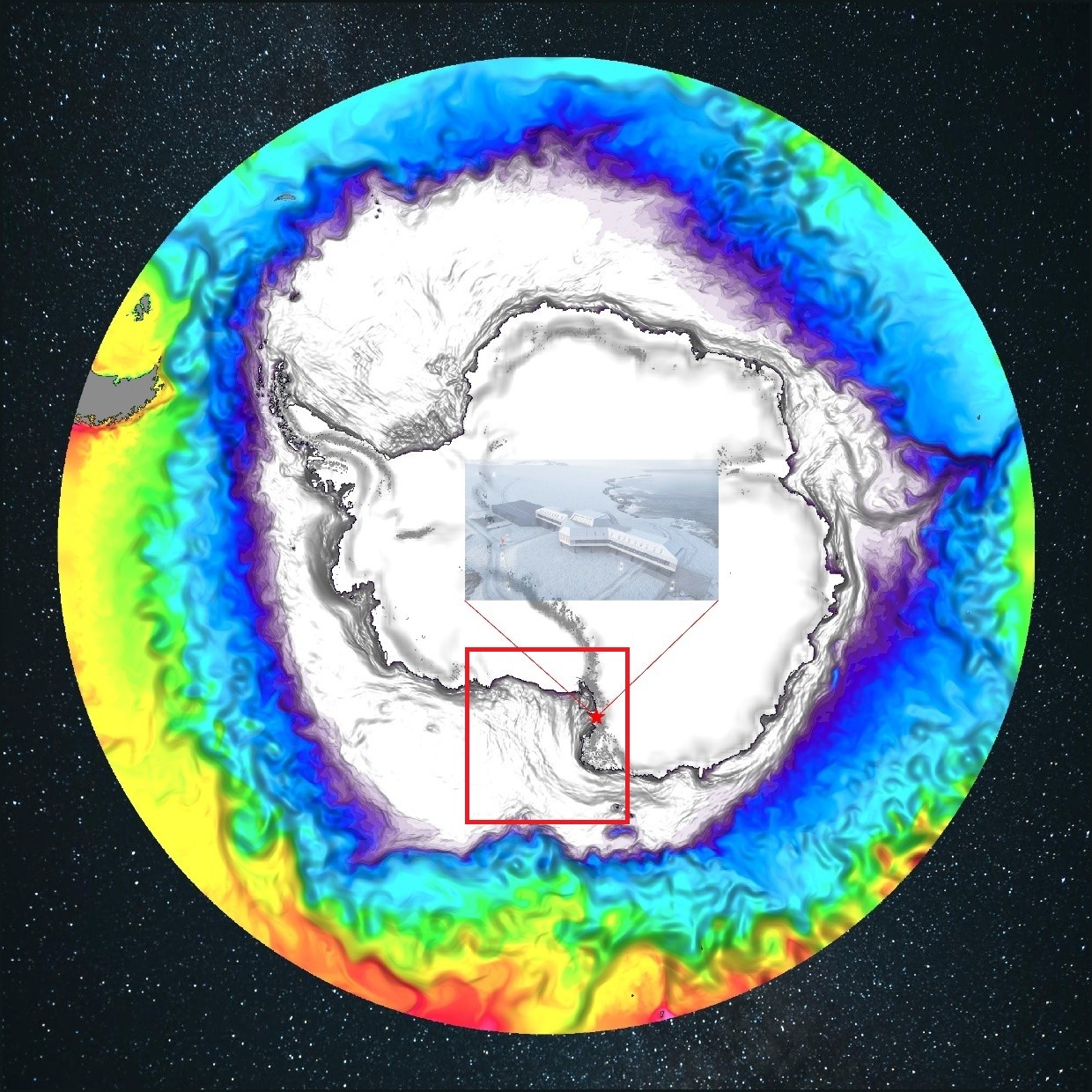 Figure 1. Schematic of the Ross Sea. The red rectangle indicates the geographical location of the Ross Sea. Colored shading represents the dynamic ocean topography of the Southern Ocean, while white shading illustrates the distribution of winter sea-ice concentration (with intensity indicating ice thickness). The red star marks the location of China's Qinling Station. The translucent inset shows the main structure of Qinling Station and its surrounding topographic features.
Given its pivotal role in the global climate system and Antarctic research, the Ross Sea has become a hotspot for international Antarctic science and a focal point in China's polar exploration strategy. In 2024, China's fifth Antarctic research station—Qinling Station (red star in Figure 1)—was officially completed and put into operation on Inexpressible Island in the Ross Sea, marking a new historical phase for China's observational and research capabilities in this region. The establishment of Qinling Station aims to enhance long-term monitoring and research in areas such as oceanography, ice shelf stability, and ecosystems in the Ross Sea, providing cutting-edge support for addressing key scientific questions in global climate change.
However, due to the Ross Sea's vast expanse, harsh environment, and prolonged polar night, extensive, high-resolution in-situ observational data remain sparse in both time and space. Numerical models remain an essential tool for bridging observational gaps, revealing physical mechanisms at the system scale, and guiding targeted observational campaigns. The Polar Ocean Group of the Frontier Research Center at the Southern Marine Science and Engineering Guangdong Laboratory (Zhuhai) has achieved a series of significant advances in understanding the Ross Sea's heat budget, energy cycle, and variability of the Antarctic Slope Current structure, based on their independently developed regional ocean-sea ice-ice shelf coupled model. These advances provide a quantitative understanding of the multi-scale physical processes in this region and establish a solid theoretical foundation for future in-situ observational research based at Qinling Station.
I. Systematic Quantification of the Ross Sea Heat Budget
The Ross Sea's heat content is influenced by a combination of ocean-atmosphere heat flux, ocean-sea ice heat flux, ocean-ice shelf heat flux, and water mass transport (Figure 2). To quantify the heat budget of the Ross Sea water masses, the research team, for the first time, conducted a systematic closed diagnostic and quantitative analysis of the heat budget for the entire Ross Sea continental shelf region, its sub-regions, and within the Ross Ice Shelf cavity.
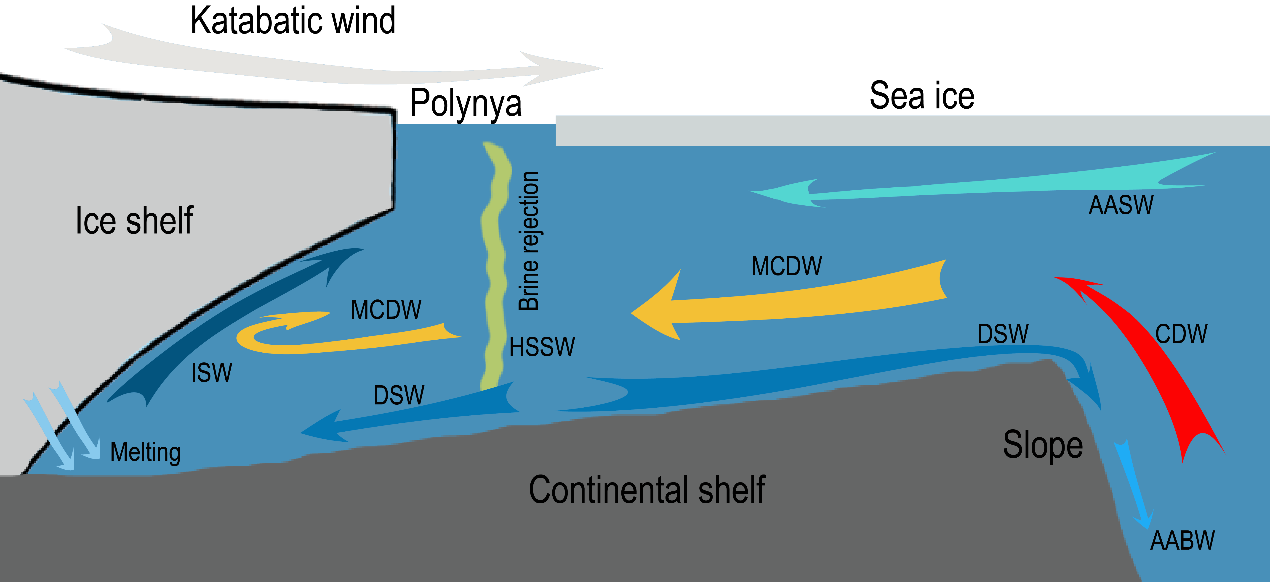
Figure 2. Schematic of water mass and heat evolution in the Ross Sea. ISW: Ice Shelf Water; MCDW: Modified Circumpolar Deep Water; DSW: Dense Shelf Water; HSSW: High-Salinity Shelf Water; AASW: Antarctic Surface Water; CDW: Circumpolar Deep Water; AABW: Antarctic Bottom Water.
Based on the complex bathymetry and thermodynamic characteristics of the Ross Sea (Figure 3a), the research team systematically classified the continental shelf, dividing it into four types: "warm trough," "warm bank," "cold trough," and "cold bank" (Figure 3b). Among these, the discovery of "warm banks" (e.g., Mawson Bank, Pennell Bank) is particularly counter-intuitive, as it challenges the traditional view that "warm water intrusion occurs only via deep troughs." Simulation results show that intermediate water layers in these bank areas also exhibit relatively high heat density, clearly indicating the presence of Modified Circumpolar Deep Water. This suggests multiple pathways for warm water intrusion into the Ross Sea. Beyond the well-known trough channels, interactions between the Antarctic Slope Current and complex topography (such as ridges, canyons, and stepped banks) may "pump" warm water from the outer slope onto bank areas through dynamic processes like upwelling and baroclinic instability, creating these unexpected "warm patches." This insight enriches the understanding of cross-slope heat exchange mechanisms and reveals the complexity of ocean dynamic processes in the Ross Sea.
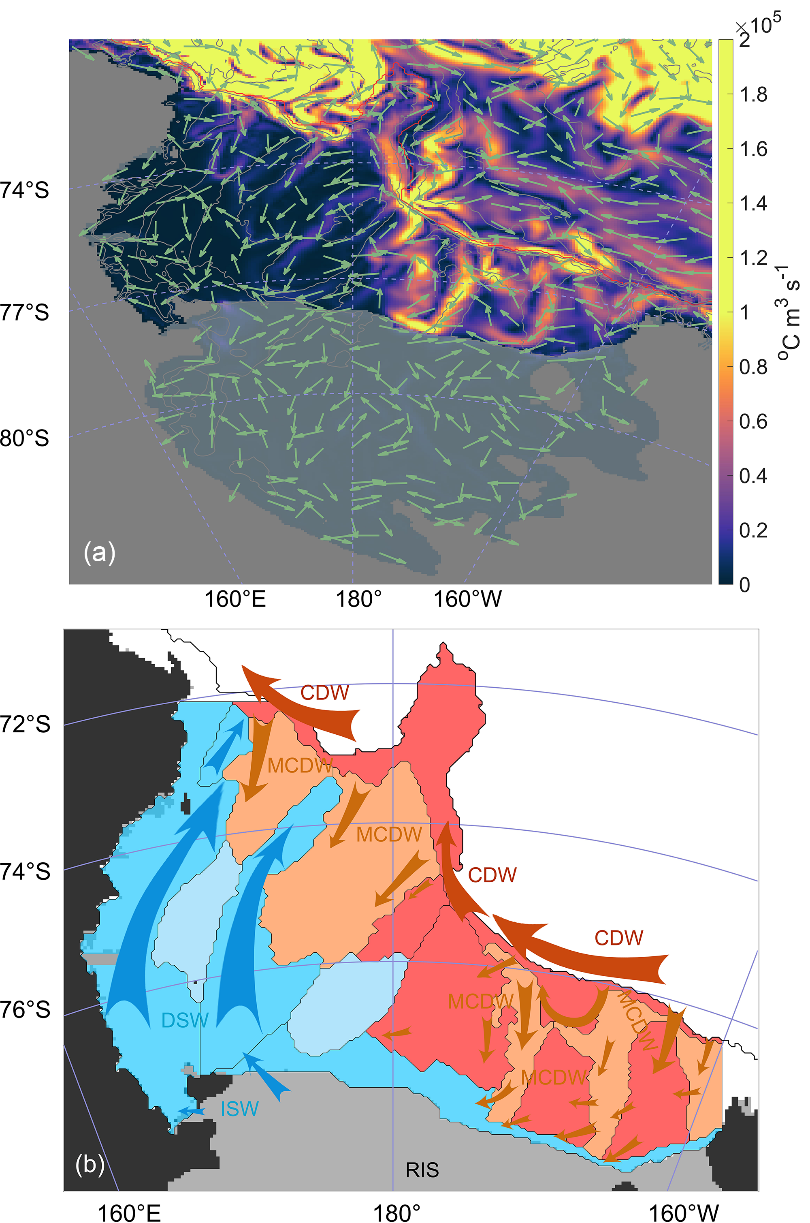
Figure 3. Schematic of heat transport and sub-region heat content on the Ross Sea shelf. (a) Mid-depth heat transport in the Ross Sea, with arrows indicating direction. (b) Schematic of Modified Circumpolar Deep Water and Dense Shelf Water transport. Different colored blocks represent the heat content characteristics of the four bathymetric types: warm trough, warm bank, cold trough, and cold bank.
Within the Ross Ice Shelf cavity, isolated from direct atmospheric forcing, some international research perspectives tend to attribute thermal changes primarily to basal melting/freezing of the ice shelf. However, this study quantitatively reveals for the first time that the seasonal cycle of heat content within the cavity is primarily controlled by horizontal heat fluxes across the ice shelf front, whose contribution far exceeds direct heat exchange at the ice shelf base (Video 1). Modified Circumpolar Deep Water input from the east and Dense Shelf Water input from the west constitute the main heat sources within the cavity. Additionally, sun-heated surface water intruding via the "wedge mechanism" in summer provides a significant heat source for basal melting on the northwestern side of the ice shelf.
Video 1. 3D visualization of oceanic summer heat content within the Ross Ice Shelf cavity.
II. First Mapping of the Ross Sea Energy Cycle
To further understand the energy mechanisms regulating Ross Sea heat content, the research team, based on Lorenz energy cycle theory, systematically analyzed for the first time the energy reservoirs and conversion pathways within the Ross Sea and its ice shelf cavity, revealing energy characteristics distinct from those of the open Southern Ocean.
The study precisely quantified four energy reservoirs in the Ross Sea. Results show that Mean Available Potential Energy (MAPE) is the largest reservoir, reflecting the strong ocean fronts maintained by wind, buoyancy forcing, and complex topography. This is followed by Eddy Available Potential Energy (EAPE), Mean Kinetic Energy (MKE), and Eddy Kinetic Energy (EKE). The narrow band-like distribution of MKE indicates the stability of mean flows like the shelf circulation and Antarctic Slope Current (Video 2), while the smooth distribution of EKE reflects the ubiquity of mesoscale eddy activity.
Video 2. 3D visualization of Mean Kinetic Energy (Joules per cubic meter) over the Ross Sea shelf.
The energy cascade within the Ross Sea system still follows the classic baroclinic instability pathway: MAPE transfers to EAPE and then converts to EKE—that is, releasing MAPE into EKE via baroclinic instability processes (Video 3). Inside the Ross Ice Shelf cavity, where wind stress input is absent, the energy cycle is entirely driven by buoyancy forcing (the "ice pump" effect). The energy path is consistent with the open ocean but an order of magnitude weaker. Here, the conversion from MAPE to MKE is the primary energy source sustaining the mean sub-ice circulation.
Video 3. 3D visualization of Eddy Kinetic Energy (Joules per cubic meter) over the Ross Sea shelf.
III. Decoding the Bimodal Structure of the Antarctic Slope Current
To further grasp the dynamics governing the Ross Sea shelf's heat budget and energy cycle, the research team systematically analyzed the spatial structure and maintenance mechanisms of the Antarctic Slope Current/Slope Front—the "northern gatekeeper" of the Ross Sea shelf. The Antarctic Slope Current is a strong current system coupled with and residing on the Antarctic slope, playing a crucial barrier role in regulating the exchange of water masses, heat, and nutrients between the shelf and the deep ocean.
The study found that in the eastern Ross Sea, the Antarctic Slope Current manifests as a surface-intensified westward flow, with its core located on the upper slope. In contrast, in the western Ross Sea, it transforms into a bottom-intensified flow, with the strongest current core near the shelf break (Figure 4). This dichotomy in dynamic structure aligns closely with the thermodynamically defined division between the "Fresh Shelf" and "Dense Shelf."
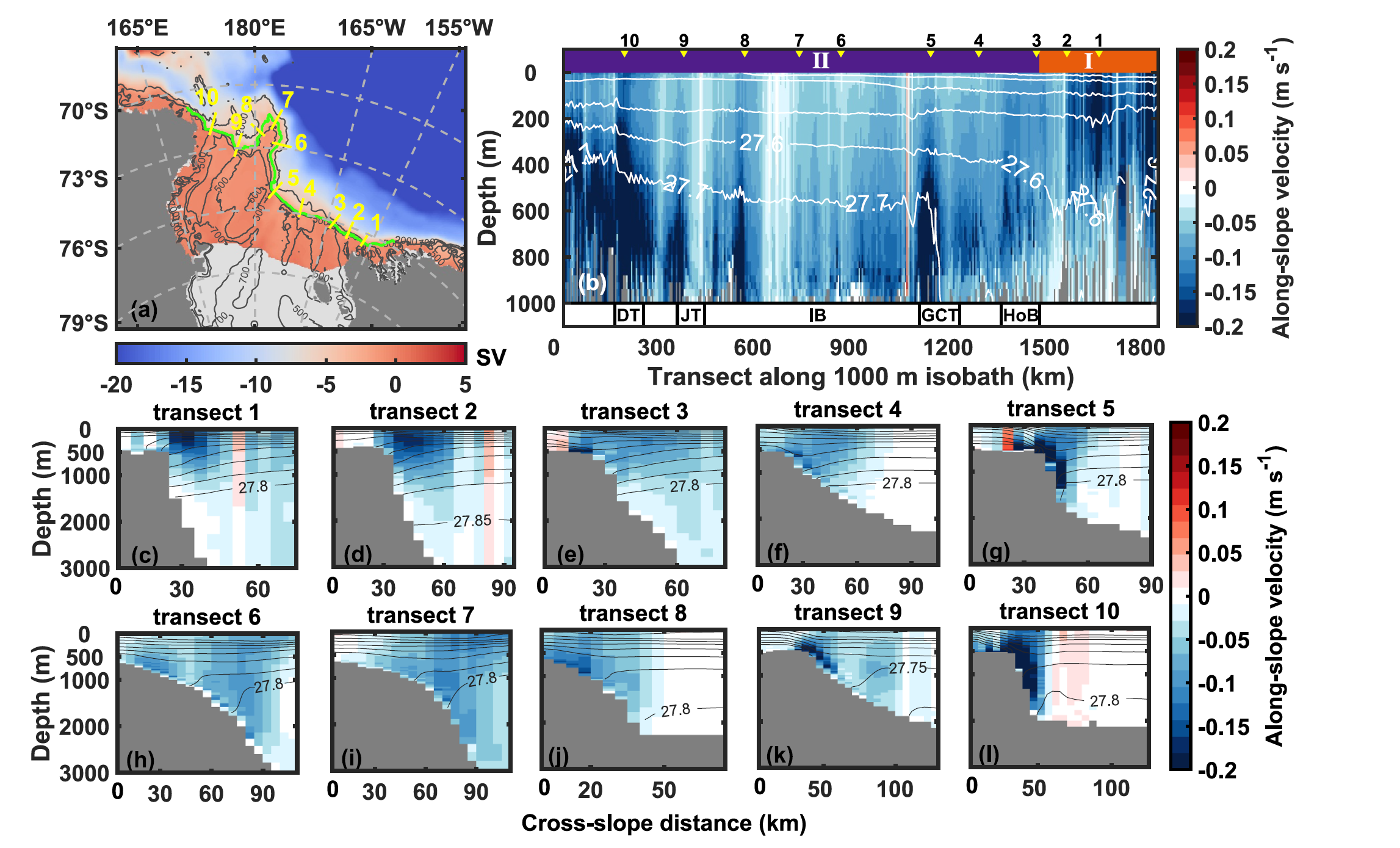
Figure 4. (a) Barotropic streamfunction, with the green line indicating the 1000-meter isobath. Yellow lines indicate cross-slope transects. (b) Along-slope velocity along the 1000-meter isobath, showing the spatial transition of the Antarctic Slope Current from surface-intensified in the east to bottom-intensified in the west. White lines are potential density σ₀ contours at 0.1 kg m⁻³ intervals. (c-l) Along-slope velocity on cross-slope transects, with grey lines as σ₀ contours at 0.05 kg m⁻³ intervals.
Through momentum budget analysis in an isobath-following coordinate system, the research team clarified the dominant dynamics for each mode. In the eastern Ross Sea, the flow is primarily driven by the barotropic pressure gradient (related to sea surface height gradient). The prevailing easterly wind-driven onshore Ekman transport causes water accumulation near the coast, generating this barotropic pressure gradient. In the western Ross Sea, the baroclinic pressure gradient (related to density gradient) becomes dominant, closely linked to the "V-shaped" uplift of isopycnals caused by the overflow of Dense Shelf Water, forming a density structure conducive to bottom flow intensification.
The research team provided a deeper explanation for these two dynamic mechanisms through energy analysis (Figure 5). In the eastern Ross Sea, the wind-driven Ekman transport not only drives the flow but also drives the conversion from MKE to MAPE—a process essentially converting kinetic energy into potential energy to maintain and strengthen the density gradient of the Slope Front, thereby inhibiting warm water intrusion. In the western Ross Sea, the situation is completely reversed. The downslope flow of dense shelf water releases its immense gravitational potential energy—that is, MAPE converts to MKE. This potential energy release process directly accelerates the bottom-intensified Antarctic Slope Current, amounting to three times the wind power input, highlighting the absolute dominance of buoyancy forcing in this regime.
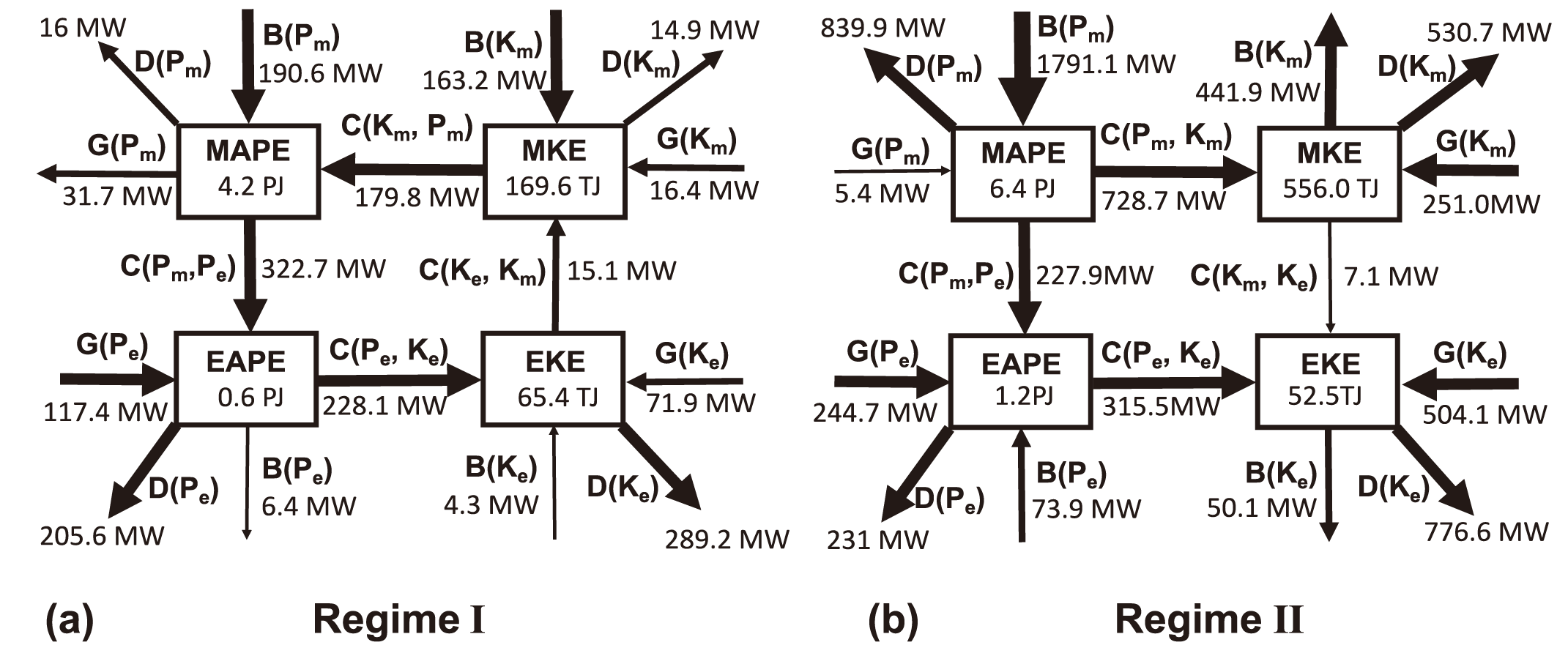
Figure 5. Energy budgets for the slope regions in the eastern (a) and western (b) Ross Sea. Energy reservoir units are PJ or TJ. Generation, conversion, dissipation, and boundary flux rates are in MW. Arrows indicate energy transfer direction, with four line thicknesses corresponding to four orders of magnitude of flux size, ranging from 100 MW to 103 MW.
Thus, the research team finds that the Antarctic Slope Current in the Ross Sea is akin to a new-energy hybrid vehicle speeding along a slope highway. The vehicle's fuel engine is the persistently working Polar Easterlies, which provide the fundamental westward momentum by driving Ekman transport. The vehicle's high-performance energy storage battery is the Antarctic Slope Front spanning the slope, storing the immense Mean Available Potential Energy constituted by density contrasts. When this hybrid vehicle enters the eastern Ross Sea, the road is relatively flat, and the engine (Polar Easterlies) is the main power source. However, as it travels, it effectively enters a ‘kinetic energy recovery deceleration zone’: a portion of the Mean Kinetic Energy is continuously converted into Mean Available Potential Energy, used to maintain and charge the Slope Front battery. This process, while consuming some kinetic energy, strengthens the barrier inhibiting warm water intrusion. When the vehicle enters the western Ross Sea, the topography and water mass conditions change dramatically. Here, the direct driving force of the engine (Polar Easterlies) weakens significantly, but the vehicle's electric motor kicks into high gear—this is the potential energy release process triggered by dense shelf water overflow. The vast Mean Available Potential Energy stored in the battery (Antarctic Slope Front) is released in large quantities, rapidly converting into Mean Kinetic Energy, propelling the hybrid vehicle as a powerful bottom-intensified jet stream accelerating out of the Ross Sea.
For the first time, the research team has constructed a complete heat budget map for the Ross Sea "shelf-ice shelf" system, drawn a comprehensive energy cycle diagram for the entire Ross Sea, and organically linked the spatial structure, dynamic balance, and energy sources of the Antarctic Slope Current in the Ross Sea, forming a complete cognitive chain from phenomenon to mechanism. This series of studies deepens the understanding of sea ice-ocean-ice shelf interactions in the Ross Sea, clarifies how the Antarctic Slope Current, through different dynamic-energy mechanisms, plays the roles of both "barrier" and "conduit" in different regions, and provides key mechanistic insights for predicting cross-slope water exchange, bottom water formation, and ice shelf basal melt under future climate change and their responses to climate change.
This series of research findings were published in 2025 inJournal of Geophysical Research-Oceans,Acta Oceanologica Sinica, andAdvances in Atmospheric Sciences, respectively. Ph.D. candidate Yang Liu, Master's student Kechen Liu, and Master's student Jiabao Zeng from the School of Atmospheric Sciences, Sun Yat-sen University, are the first authors of the three papers. Dr. Liangjun Yan from the School of Marine Sciences, Sun Yat-sen University, led the numerical model development. Associate Researcher Chengyan Liu of the Polar Ocean Group at the Frontier Research Center of the Southern Marine Laboratory is the corresponding author for the series.
This research was supported by the National Key Research and Development Program of China, the Southern Marine Science and Engineering Guangdong Laboratory (Zhuhai) Independent Research Project, and the General Program of the Natural Science Foundation of Guangdong Province.
Source link:
https://doi.org/10.1029/2025JC023219
https://doi.org/10.1007/s13131-025-2478-0
https://doi.org/10.1007/s00376-025-4391-z
Preliminary Reviewer: Zhaomin Wang
Authors: Yang Liu, Kechen Liu, Jiabao Zeng
Contributors: Yang Liu, Kechen Liu, Jiabao Zeng